Personal Story
I Loved Coffee. My Stomach Didn't. So I Found This.
If your afternoon coffee is followed by a bathroom emergency, this might be the most important thing you read this week.
It's 2:47 PM on a Tuesday.
You're sitting at your desk, staring at a half-written email that should have taken five minutes. Your brain checked out twenty minutes ago. Next to your keyboard, your third coffee of the day is going cold.
You know what happens if you drink it. Your stomach already told you at lunch — that familiar burn creeping up your chest, the bloating, the quiet dread of knowing you'll be sprinting to the bathroom in about forty minutes.
But if you don't drink it, this project isn't getting done before 6.
So you drink it. Again. Like you did yesterday. Like you'll do tomorrow.
And you hate yourself a little bit for it.

Here's the Thing Nobody Talks About at the Office
Coffee is wrecking your gut.
Not in some vague, "maybe in 20 years" kind of way. Right now. Today. Every single cup.
The acid in coffee is brutal. It irritates your stomach lining, triggers acid reflux, and sends your digestive system into overdrive. That's why you know exactly where every bathroom is in your office building. That's why you skip the morning meeting snack because you know what's coming after your second cup.
He's not alone. Scroll through any productivity forum, any health subreddit, any gastroenterologist's waiting room — and you'll find the same story repeated thousands of times.
People who love caffeine. People who need caffeine. People whose bodies can't handle it anymore.
Let's Be Honest About What This Actually Looks Like
It's the acid reflux that hits at 3 PM, right when you're supposed to be in a client call. It's the bloating that makes your pants feel tight after lunch. It's the urgent bathroom trip during a meeting where you have to pretend you "just need to grab something from your desk."
It's the Sunday night realization that you spent $42 on coffee this week — and all you got in return was jitters, a wrecked stomach, and a crash so hard you fell asleep on the couch at 4 PM.
Crude? Sure. But if you've lived it, you know exactly what they mean.
The worst part isn't the discomfort. The worst part is feeling trapped.
You can't quit caffeine — you literally cannot function without it. Your job demands focus. Your life demands energy. But the only delivery system you've ever known is slowly destroying your digestive system.
So you keep drinking. And your gut keeps paying the price.
You've Tried the Alternatives. Of Course You Have.
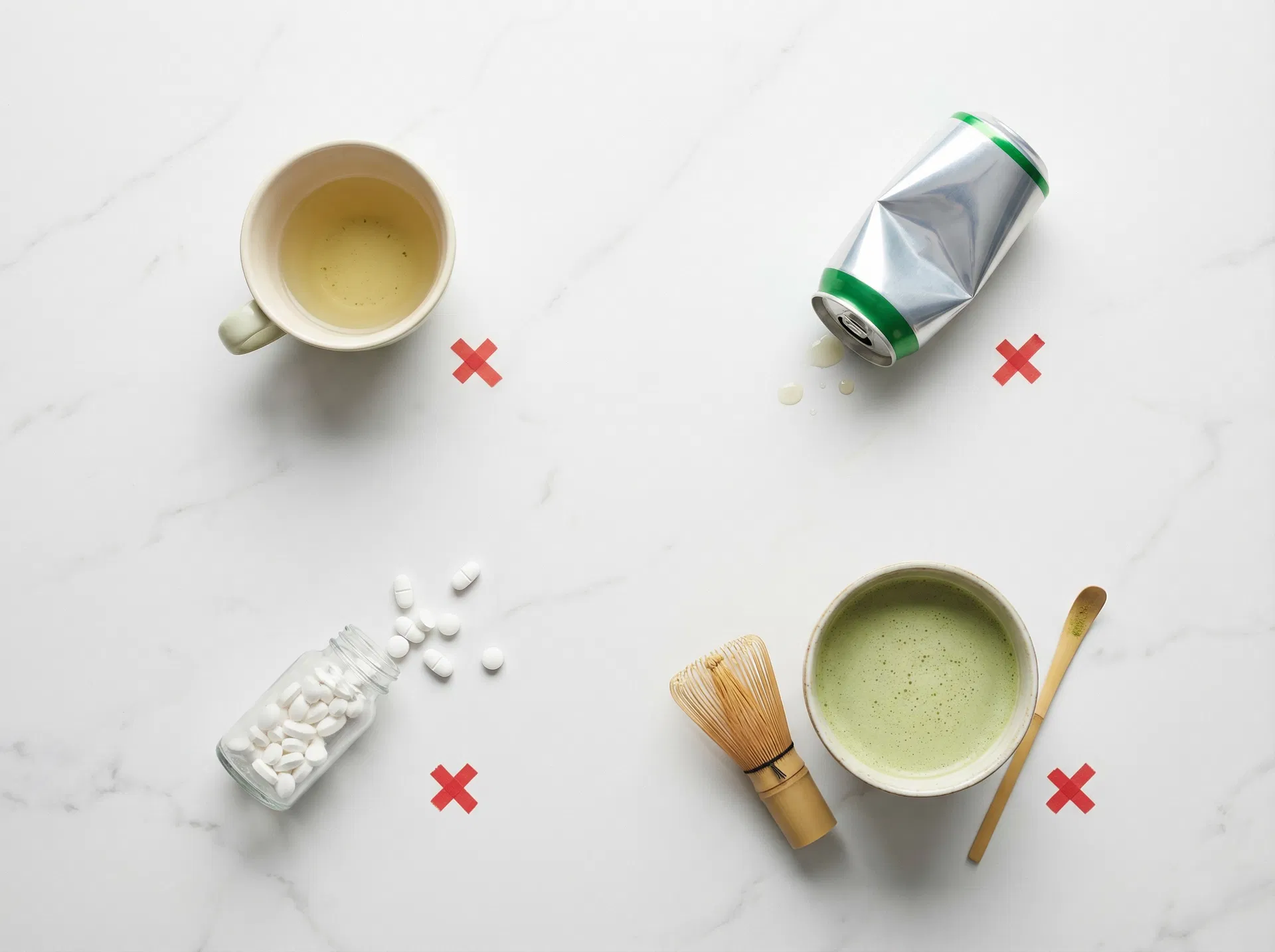
Green tea. Tastes fine. But 25mg of caffeine when you're used to 200mg? You might as well drink hot water. You were asleep at your desk by 2 PM.
Energy drinks. Traded stomach acid for heart palpitations and a sugar crash so violent you could feel it in your teeth. Plus, nothing says "I have my life together" like cracking open a Monster in a board meeting.
Caffeine pills. Clinical. Imprecise. You either took too much and felt like your heart was going to explode, or too little and felt nothing. No ritual. No control. Just swallowing a pill and hoping for the best.
Matcha. You tried. You really tried. You bought the whisk, the bamboo scoop, the ceremonial-grade powder from Japan. It lasted eleven days. The preparation time alone was longer than your actual break.
None of them worked. Because none of them solved the real problem.
The problem was never caffeine itself.
The problem was always how you were putting it into your body.
I Stumbled Onto This by Accident
I was deep in a Reddit thread at midnight — the kind where people are brutally honest because they're anonymous and exhausted — and someone mentioned that the military had been using caffeinated gum for decades.
Not as a supplement. Not as a biohack. As standard-issue equipment for pilots and special forces who needed to stay sharp without access to coffee or energy drinks.
The key detail that stopped my scrolling:
"The caffeine in gum is absorbed through the lining of your mouth. It never reaches your stomach."
I read that three times.
Never. Reaches. Your. Stomach.
That meant no acid. No reflux. No bloating. No bathroom emergencies. The caffeine goes directly from the thin membranes inside your cheeks into your bloodstream. It completely bypasses the entire digestive system.
And it works in about 5 minutes. Not 30-45 like coffee.
I thought: if this is real, why isn't everyone doing this?
The Science
Here's the Science, Stripped Down to What Actually Matters
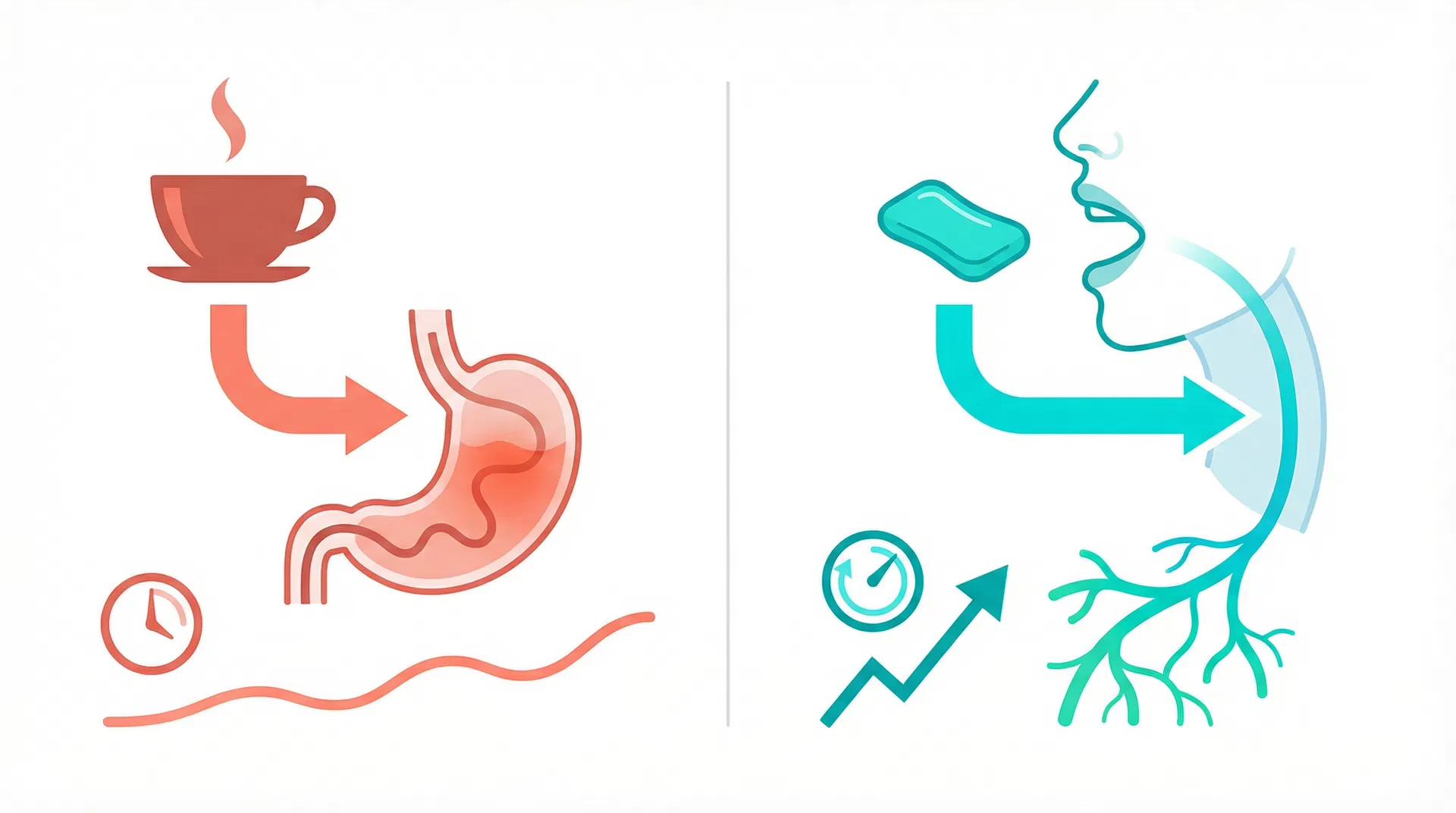
The inside of your mouth — specifically your cheeks and the area under your tongue — is lined with incredibly thin tissue packed with tiny blood vessels. Doctors call this the "buccal mucosa." It's the same pathway they use to deliver emergency heart medication when seconds count.
When you chew caffeinated gum, the caffeine dissolves and gets absorbed directly through these membranes. It enters your bloodstream almost immediately. Clinical studies have shown that buccal absorption delivers caffeine to your brain roughly twice as fast as swallowing a capsule or drinking a liquid.
But here's the part that matters for your gut:
The caffeine never enters your digestive tract.
No stomach acid interaction. No intestinal irritation. No triggering your gastric system. Your gut doesn't even know it happened.
It's not a workaround. It's not a "gentler" version of coffee. It's a completely different delivery pathway that makes the stomach issue disappear entirely.
The Solution
That's Exactly What Gum+ Is Built On
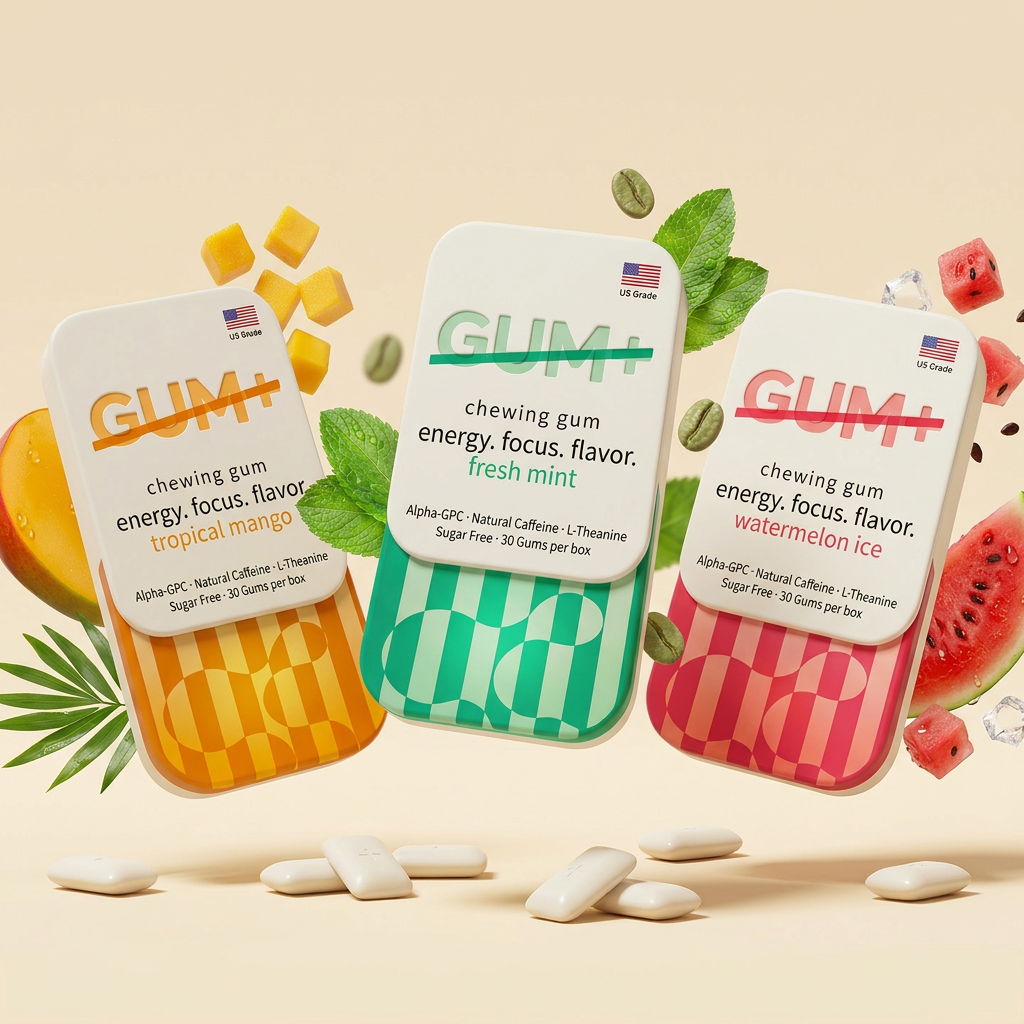
Gum+ Energy & Focus Gum
50mg Caffeine + L-Theanine per piece · 30 pieces per pack
· Sugar-free · Aspartame-free
Gum+ is not a supplement pretending to be gum. It's a real chewing gum — the kind that actually tastes good, holds its texture, and feels normal in your mouth — that happens to deliver clean, precise caffeine through buccal absorption.
Each piece contains 50mg of caffeine paired with L-Theanine at a 2:1 ratio. If you're not familiar with L-Theanine, it's a naturally occurring amino acid found in green tea. It's the reason green tea gives you calm focus instead of jittery anxiety.
When you combine caffeine with L-Theanine, something remarkable happens. The caffeine gives you the alertness and the cognitive boost. The L-Theanine smooths out the edges — no jitters, no racing heart, no anxious energy. Neuroscientists call this combination "smart caffeine." It's the most studied nootropic stack in existence.
The result: you feel focused. Not wired. Not buzzing. Just... clear.
One piece. Five minutes. And your afternoon completely changes.
The Afternoon, Reimagined

That's not marketing copy. That's the difference between dumping acid into your gut and bypassing it entirely.
What People Actually Notice When They Switch
- The bathroom thing stops. This is the first thing everyone mentions. The urgent, coffee-triggered bathroom runs just... stop. Because there's nothing irritating your digestive system anymore.
- The jitters disappear. The L-Theanine neutralizes the anxious, shaky feeling that caffeine alone creates. You feel alert, not wired. One user described it as "the difference between a spotlight and a strobe light."
- The crash doesn't come. Because buccal absorption delivers caffeine more gradually than a liquid bolus hitting your stomach, the energy curve is smoother. No spike means no crash.
- You actually sleep. Because you're not over-caffeinating to compensate for the crash, and because each piece is a precise 50mg dose, you can time your last piece and actually be tired at bedtime.
- It fits in your pocket. No cups. No cans. No brewing. No spilling. No "can you hold my coffee?" You just chew. Anywhere. Anytime.
Real People. Real Reviews. No Paid Influencers.
These aren't influencers. They're people who tried something, and it worked.
You Might Be Wondering...
"But doesn't caffeinated gum taste terrible?"
Most of them? Yes. Honestly, yes. The military version tastes like chewing a battery. Most commercial brands have a chalky, bitter aftertaste that makes you question your life choices. This is the #1 complaint across every competitor review we've read. Gum+ was formulated specifically to solve this. It's a real gum with real flavor that lasts. Not a supplement disguised as gum.
"Is 50mg enough? I drink like 3 coffees a day."
A standard cup of coffee is about 95mg. But here's the thing — because buccal absorption is roughly twice as efficient as stomach absorption, 50mg through your cheeks hits differently than 50mg through your gut. Most people find that one piece replaces their afternoon coffee entirely. If you need more, chew two. You're in control of the dose — something coffee never gave you.
"Isn't this just another supplement gimmick?"
Gum+ isn't positioned as a supplement. It's a gum. It sits next to your keys and your phone. You chew it when you need focus. There's no pill organizer, no mixing powder, no "stack" to optimize. The science behind buccal caffeine absorption has been validated by military research and published clinical studies. This isn't new — it's just finally available in a format that doesn't taste like punishment.
"What if it doesn't work for me?"
Then you get your money back. Gum+ comes with a 30-day guarantee. Try it for a full month. If you don't feel the difference — in your focus, in your gut, in your afternoons — you get a full refund. No questions. No hoops.
Your Stomach Has Been Begging You to Make This Switch
You've been drinking coffee for years. Maybe decades. And somewhere along the way, your body started pushing back. The stomach issues. The reflux. The bloating. The crash-and-burn cycle every afternoon.
You don't need to quit caffeine. You just need to stop forcing it through your stomach.
One piece. Five minutes. Zero gut issues.
Try Gum+ Risk-Free →If you don't feel the difference, you don't pay. Full refund. No questions asked.
Each pack contains 30 pieces · Sugar-free · Aspartame-free · Made in the USA · Ships free on orders over $30

[1] Kamimori, G. H., et al. (2002). "The rate of absorption and relative bioavailability of caffeine administered in chewing gum versus capsules to normal healthy volunteers." International Journal of Pharmaceutics.
[2] Haskell, C. F., et al. (2008). "The effects of L-theanine, caffeine and their combination on cognition and mood." Biological Psychology.
[3] Yang, A., et al. (2024). "Sublingual absorption of caffeine: Pharmacokinetics and cognitive performance." Journal of Clinical Pharmacology.
Advertisement · Gum+ is not intended to diagnose, treat, cure, or prevent any disease.